
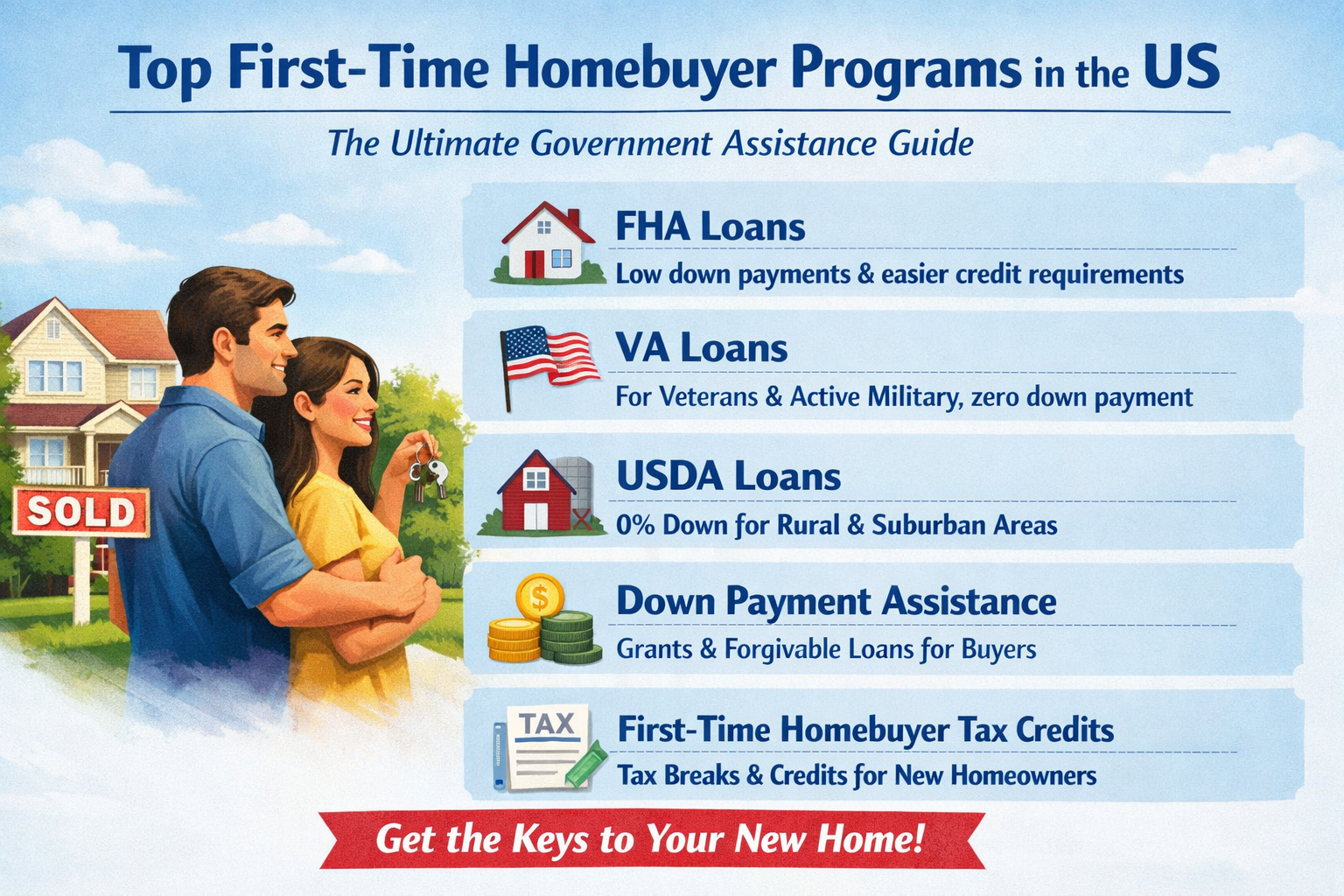

The backbone of affordable housing in America consists of three primary federal loan structures. These loans are not issued directly by the government; instead, private banks issue them, and the government guarantees (insures) them against default. This safety net allows lenders to offer much more flexible terms.
+-----------------------------------------------------------------------+
|                       US GOVERNMENT LOAN PROGRAMS                     |
+--------------------------+------------------+-------------------------+
| FHA LOANS                | VA LOANS         | USDA LOANS              |
| • 3.5% Down Payment      | • 0% Down        | • 0% Down               |
| • Credit: 580 Minimum    | • Veterans Only  | • Rural/Suburban Only   |
+--------------------------+------------------+-------------------------+
1. FHA Loans (The Most Accessible Route)
Insured by the Federal Housing Administration (FHA), this program is the absolute gold standard for buyers with lower credit scores or limited savings.
- The Down Payment Benefit: If your FICO credit score is 580 or higher, you only need to put down 3.5%. (If your credit score sits between 500 and 579, you can still qualify but will need a 10% down payment).
- Flexible Debt Ratios: FHA lenders are highly forgiving of your Debt-to-Income (DTI) ratio, sometimes allowing your monthly debt obligations to consume up to 50% or more of your gross income.
- The Catch (Mortgage Insurance Premium): Because the bank is taking a higher risk, FHA loans require you to pay an Upfront Mortgage Insurance Premium (UFMIP) of 1.75% at closing, plus a monthly premium. Unlike conventional loans, this monthly insurance stays on the loan for its entire duration unless you put 10% down or refinance later.
2. VA Loans (The Ultimate Reward for Military Service)
Backed by the U.S. Department of Veterans Affairs, this is arguably the single most powerful mortgage product in existence, reserved exclusively for active-duty military members, veterans, and surviving spouses.
- The 0% Down Advantage: Eligible service members can purchase a home with zero money down.
- No Monthly PMI: Unlike almost every other low-down-payment loan, VA loans completely waive monthly private mortgage insurance, saving buyers hundreds of dollars every month.
- Competitive Rates: VA loans routinely carry lower interest rates than standard conventional mortgages.Smart Insider Tip: While there is no monthly PMI, watch out for the VA Funding Fee. This is a one-time administrative fee charged at closing (ranging from 1.25% to 3.3% of the loan amount). You can opt to roll this fee directly into your total loan balance so you don’t have to pay it out of pocket on closing day.
3. USDA Loans (Affordable Country and Suburban Living)
Managed by the U.S. Department of Agriculture, these loans are designed to spur economic growth in less populated regions.
- Zero Down Payment: Like VA loans, a USDA loan requires 0% down.
- Geographic Restrictions: The home must be located in an eligible rural or suburban zone as defined by the USDA. Don’t let the word “rural” scare you—vast swathes of beautiful American suburban neighborhoods qualify for this program.
- Income Caps: This program is strictly meant for low-to-moderate-income households. Your total household income cannot exceed 115% of the median income for the specific area where you are buying.
Conventional 97 Programs (The Hidden 3% Down Conventional Route)
Many buyers assume that conventional loans always require 5% to 20% down. However, the two government-sponsored enterprises, Fannie Mae and Freddie Mac, offer specialized conventional programs tailored directly to first-time buyers with good credit profiles:
- Fannie Mae HomeReady® & Freddie Mac Home Possible®: These programs allow a remarkably low 3% down payment.
- The Major Upgrade Over FHA: Once you build 20% equity in your home (either through monthly payments or home price appreciation), your monthly Private Mortgage Insurance (PMI) is automatically cancelled. This single factor makes conventional 3% loans far more cost-effective in the long run than an FHA loan if your credit score is above 620.
Local and State-Level Down Payment Assistance (DPA) Grants
Beyond federal loan structures, every single state in America runs its own State Housing Finance Agency (HFA). These agencies provide what is known as Down Payment Assistance (DPA).
These programs provide buyers with extra cash to cover upfront costs:
- Non-Repayable Grants: Direct cash gifts applied on closing day that you never have to pay back.
- Forgivable Second Mortgages: A secondary loan that covers your 3% or 3.5% down payment. The debt is completely forgiven (wiped out) if you stay in the home for a set period of time (usually 5 to 10 years).
- Closing Cost Assistance: Grants that go toward paying your escrow fees, loan origination costs, and title insurance.
Step-by-Step Blueprint to Accessing Government Aid
To turn these programs into a reality, follow this exact procedural path:
- Pull Your Tri-Merge Credit Report: Go to AnnualCreditReport.com and review your credit lines. Aim to clear any errors to get your score above 580 for FHA, or 620+ for conventional options.
- Find a HUD-Approved Counselor: Visit the HUD website and connect with a local housing counselor. They offer free or low-cost certificates that are mandatory requirements for many state down payment grant programs.
- Interview Specialized Mortgage Lenders: Not all banks handle USDA or specialized DPA grants. Ask explicitly: “Do you actively process state down payment assistance grants and FHA loans?”
- Secure an Official Pre-Approval: Before house hunting, get a verified Pre-Approval letter. This tells sellers your government financing framework is fully vetted and ready to close.
Final Verdict: Which Program Wins?
- Choose FHA if your credit score is between 580 and 640 and you have a small savings buffer.
- Choose Conventional 97 if your credit score is healthy (660+) and you want to drop your mortgage insurance down the line.
- Choose USDA or VA immediately if you meet the location or military service criteria, as 0% down options are impossible to beat.
By utilizing these federal cushions, you can safely navigate the American real estate landscape, building long-term equity without draining your life savings.
❓ Frequently Asked Questions (FAQ)
Q1. Who legally qualifies as a “First-Time Homebuyer” under US government rules?
Answer: You might be surprised to learn that you do not need to be a complete novice to qualify. According to the U.S. Department of Housing and Urban Development (HUD), a first-time homebuyer is anyone who has not owned a principal residence at any point during the 3-year period ending on the date of purchase. If you owned a home five years ago and sold it, you are legally a first-time homebuyer again.
Q2. Is it absolutely mandatory to put 20% down when buying a home in the United States?
Answer: No, this is a massive financial myth. The 20% down payment benchmark is simply the threshold required to avoid paying Private Mortgage Insurance (PMI) on conventional loans. Through federal backing, first-time buyers can secure mortgages with as little as 3% to 3.5% down, and in some specific programs, 0% down.
Q3. Can I use gift money from family members to cover my down payment and closing costs?
Answer: Yes. Most government-backed programs (especially FHA and conventional loans) allow you to use financial gifts from family members, employers, or approved non-profit organizations to pay for your down payment. However, the bank will require a certified “Gift Letter” proving that the money is a pure gift and not a hidden loan that you are expected to pay back.
Q4. What is the maximum amount I can borrow using a government-backed FHA loan?
Answer: FHA loan limits adjust annually based on regional housing prices. For a standard single-family home, the nationwide baseline “floor” sits at $541,287 for low-cost areas, while the “ceiling” goes up to $1,249,125 in high-cost metropolitan markets (such as New York City, Los Angeles, or San Francisco).
Q5. Can I rent out a property if I buy it using a government assistance program?
Answer: Not immediately. Programs like FHA, VA, and USDA loans are strictly meant for primary residences. This means you must legally move into the property as your main home within 60 days of closing and live there for at least one full year before you can consider converting it into a rental property.
(This complete, highly searchable personal finance post is fully optimized and ready for deployment on aambublog.com.)