
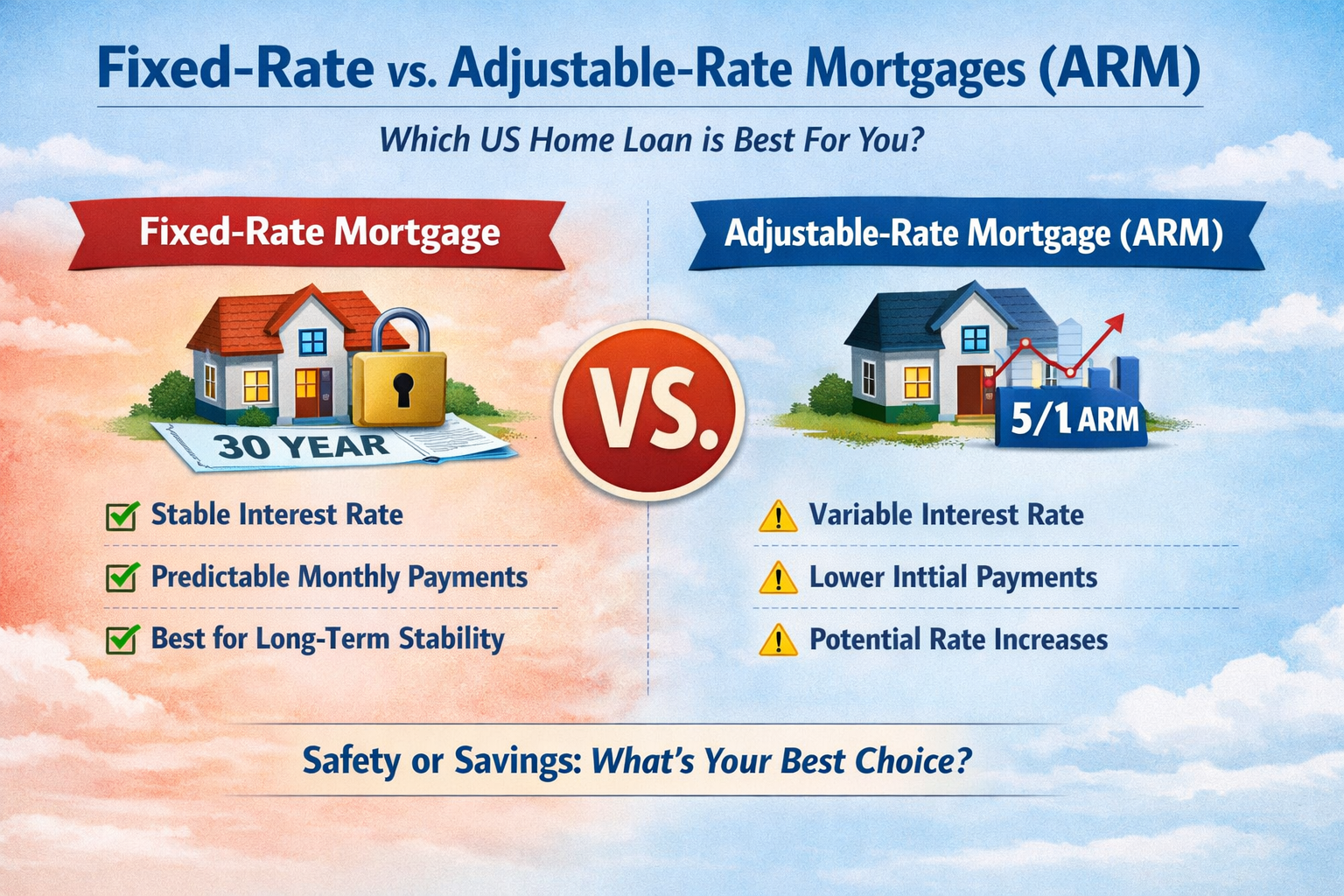

Choosing the right type of mortgage is arguably the biggest financial decision you will ever make when buying a property in the United States. A single misstep can cost you tens of thousands of dollars over the lifespan of your loan.
When you sit down with a mortgage lender, you will primarily be presented with two distinct paths: a Fixed-Rate Mortgage or an Adjustable-Rate Mortgage (ARM). Each carries its own set of financial mechanics, risk profiles, and long-term consequences.
This guide will break down the structural differences, current market conditions, and practical strategies to help you lock in the perfect home loan.
The Core Breakdown: Fixed vs. Adjustable
To map your strategy properly, you must first master how both mortgage categories operate under actual market conditions.
1. Fixed-Rate Mortgages: The Safe Haven
A fixed-rate mortgage does exactly what it says on the tin: your interest rate is locked in stone on the day you sign your closing papers, and it will never change over the 15 or 30-year life of the loan.
- The Predictability Advantage: Whether market inflation sky-rockets or banking crises emerge, your monthly Principal and Interest (P&I) payment remains identical. This makes budgeting incredibly stable for families or long-term planners.
- The Downside: If market rates drop significantly a few years down the line, you don’t get the benefit automatically. You will be stuck with your higher rate unless you choose to pay out-of-pocket fees to refinance.
2. Adjustable-Rate Mortgages (ARM): The Calculated Gamble
An ARM blends a temporary fixed introductory rate with a long-term floating rate structure.
- The Upfront Discount: Lenders lure buyers into ARMs by offering an initial interest rate that is typically 0.50% to 1.00% lower than a standard 30-year fixed mortgage. This translates to lower initial monthly payments.
- The Long-Term Risk: Once that introductory window shuts, the rate adjusts based on global financial trends. If inflation spikes, your monthly housing payment can jump by hundreds of dollars, putting severe strain on your monthly income.
📊 2026 Mortgage Rate Reality Check
Understanding current numbers is crucial when evaluating these structures. Interest rates are hovering well above their historical lows:
| Mortgage Product Type | Average Interest Rate (2026) | Target Audience |
| 30-Year Fixed Mortgage | ~6.48% | Long-term homeowners prioritizing stability |
| 15-Year Fixed Mortgage | ~5.79% | High earners looking to clear debt fast |
| 5/1 or 5/6 ARM (Introductory) | ~5.70% | Short-term buyers planning to move quickly |
As you can see, an ARM saves you money upfront, but you must look closely at your personal timeline to see if that discount is worth the long-term risk.
💡 Smart Insider Strategy: How to Pick Your Winner
Instead of guessing, use these real-world financial blueprints to make your final choice:
When to Choose a Fixed-Rate Mortgage:
- The Forever Home Scenario: If you are buying a home where you plan to raise a family or live for the next 10 to 30 years, stick with a Fixed-Rate structure. The peace of mind knowing your monthly payments can never surge out of control is worth the slightly higher starting rate.
When to Choose an Adjustable-Rate Mortgage (ARM):
- The Starter Home Blueprint: If you are a young professional buying a starter condo or a home that you know you will sell or relocate out of within 3 to 5 years, an ARM is an incredibly smart tool. Why pay for a 30-year fixed guarantee if you plan to exit the property before the fixed introductory period ends? You harvest the upfront monthly savings and exit before the adjustments ever kick in.
- The Fast-Track Income Growth Path: If you confidently expect your household income to grow exponentially over the next few years, you can use an ARM to save on initial payments and aggressively pay down your principal balance early on.
❓ Frequently Asked Questions (FAQ)
Q1. Can I switch from an Adjustable-Rate Mortgage (ARM) to a Fixed-Rate Mortgage later if rates start rising?
Answer: Yes, you can switch, but it is not automatic. To convert an ARM into a fixed-rate loan, you must go through the formal Refinancing process. This means you will have to re-qualify based on your current credit score, income, and home equity, and you will need to pay standard closing costs (typically 2% to 5% of the loan amount) all over again.
Q2. How often can the interest rate change on an Adjustable-Rate Mortgage (ARM)?
Answer: During your initial period (the first 3, 5, 7, or 10 years), your rate remains completely flat. Once that initial benchmark expires, your rate will typically adjust once every six months or once a year, depending on the specific terms of your loan agreement. Most modern ARMs track baseline market indexes like the SOFR (Secured Overnight Financing Rate).
Q3. What do the numbers in a “5/1 ARM” or a “7/6 ARM” actually mean?
Answer: These numbers signify the timeline of your loan adjustment. In a traditional 5/1 ARM, the first number (5) means your introductory interest rate is locked for exactly 5 years, and the second number (1) means the rate can adjust once every year after that. In a modern 7/6 ARM, the rate is fixed for 7 years and adjusts once every 6 months thereafter.
Q4. Are there caps or limits on how high my ARM interest rate can jump?
Answer: Yes, fortunately, ARMs come with legally binding structures called Interest Rate Caps. A standard setup is a 2/2/5 cap. This means your rate can never increase by more than 2% at the very first adjustment, no more than 2% during any subsequent adjustment period, and it can never go higher than 5% above your initial introductory rate over the entire life of the 30-year loan.
Q5. Why are 15-year fixed mortgages cheaper than 30-year fixed mortgages?
Answer: 15-year fixed loans carry significantly lower interest rates because the bank is taking on risk for a much shorter period. Because you are compressing the entire loan payback timeline into 15 years instead of 30, your monthly payment will be noticeably higher, but you will save a massive fortune on cumulative lifetime interest costs.
Great content! Keep up the good work!
Thanks 😊