
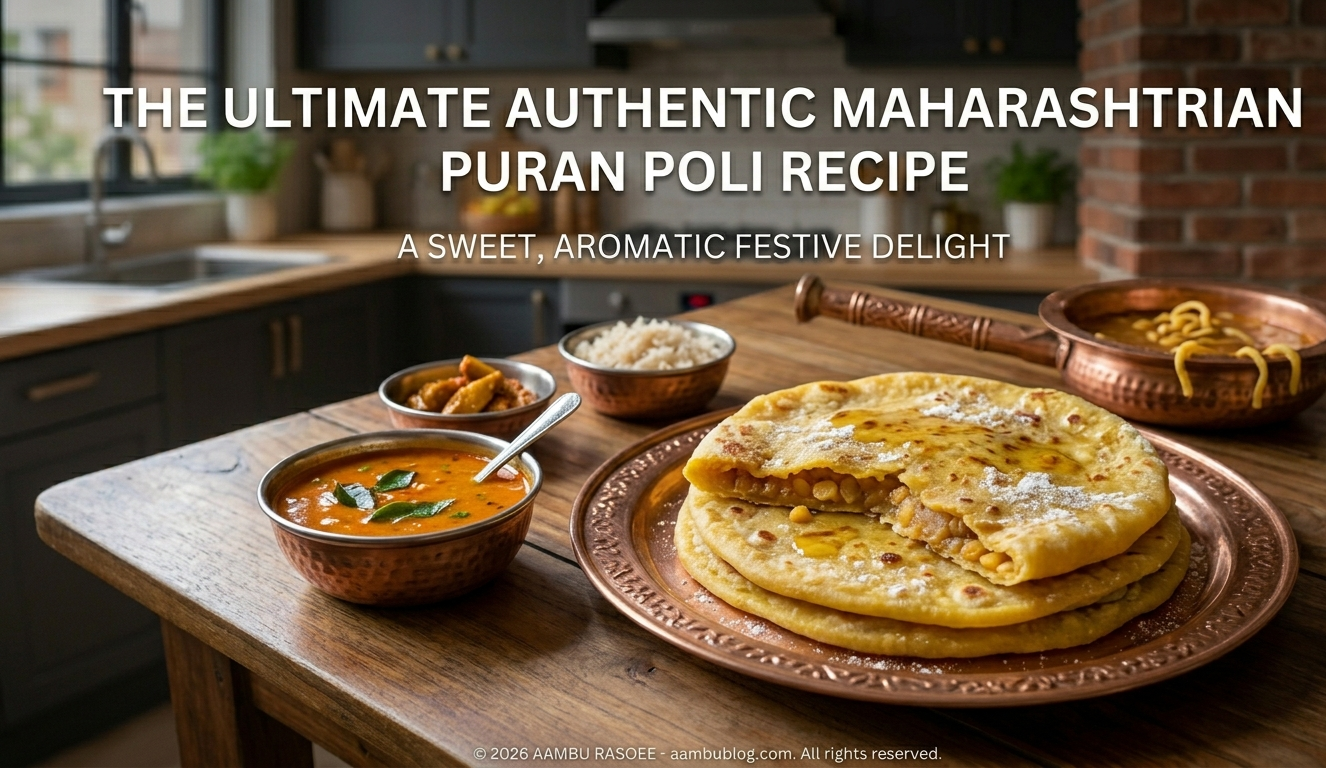
Welcome back to AAMBU RASOEE, where we bring authentic flavors from Navi Mumbai to the world. If there is one dish that defines Maharashtrian festive cooking, it is the humble yet exquisite Puran Poli.
Puran Poli is a sweet flatbread stuffed with a luscious filling of chana dal (split Bengal gram) and jaggery, flavored with aromatic spices. Mastering the ‘softness’ and the perfect stretch of the poli is an art, and today, we share the exact technique we use in our own cloud kitchen.
The Story Behind Puran Poli
Puran Poli is more than a dessert; it is a symbol of celebration. Whether it is Holi, Gudi Padwa, or Diwali, a Maharashtrian thali is incomplete without it. The key to its taste lies in balancing the deep caramel notes of jaggery with the earthy chana dal and a hint of nutmeg.
Ingredients (Serves 8-10 Polis)
For the Puran (Sweet Filling):
- Chana Dal (Split Bengal Gram): 1 Cup (Soaked for 4 hours)
- Jaggery (Gud), grated: 1 Cup (Preferably organic/dark variety)
- Water: 2.5 Cups (to cook dal)
- Green Cardamom Powder (Elaichi): 1 tsp
- Nutmeg Powder (Jaiphal): ½ tsp
- Dry Ginger Powder (Sunth): ½ tsp
For the Poli (Outer Dough):
- Whole Wheat Flour (Atta): 1 Cup
- All-Purpose Flour (Maida): 1 Cup (Adding maida gives the perfect stretch)
- Oil (Refined): 3-4 tbsp
- Turmeric Powder (Haldi): ½ tsp (for that rich yellow color)
- Salt: A pinch
- Water: To knead the dough (approx. ½ Cup)
For Topping & Rolling:
- Rice Flour (for dusting/rolling)
- Pure Ghee (Clarified Butter), melted: For cooking and serving
Step-by-Step Instructions
Step 1: Preparing the Puran (The Filling)
- Cook the Dal: Drain the soaked chana dal. In a pressure cooker, add the dal, 2.5 cups of water, and turmeric. Cook for 4-5 whistles until the dal is completely soft and mashable.
- Drain Excess Water: Strain the cooked dal through a fine sieve (colander). Keep the residual water (called Kat) aside; this is used to make Katachi Amti (a spicy side dish served with Puran Poli).
- Mix Dal and Jaggery: In a thick-bottomed copper pot or wok (like the one shown in image_14.png), combine the mashed dal and grated jaggery.
- Cook Puran: Turn on the heat (medium-low) and start stirring. The mixture will first liquefy. Continue stirring constantly to prevent it from sticking or burning.
- Test the Puran: Cook until the mixture thickens. Pro-Tip Test: Insert a clean spoon into the center of the puran. If it stands upright, the puran is ready. If it falls, it needs more cooking.
- Add Spices: Once thickened, stir in the cardamom powder, nutmeg powder, and dry ginger powder. Mix well and turn off the heat.
- The Finisher (Pass through the Puran Yantra): For that super smooth and silky texture, pass the warm puran through a traditional ‘Puran Yantra’ (a sieve-mill) or a very fine mesh sieve. This ensures there are no lumps of dal. Let it cool completely.
Step 2: Preparing the Dough (The Cover)
- Knead the Atta: In a large bowl, mix wheat flour, maida, a pinch of salt, and turmeric powder.
- Add Oil: Add 3-4 tbsp of oil and mix it well into the flour structure, creating a ‘crumb’ effect.
- Make a Soft Dough: Gradually add water and knead to form a smooth, very soft, and elastic dough. Key Requirement: The dough must be softer than your regular roti dough. Cover it with a damp cloth and let it rest for at least 1-2 hours.
Step 3: Rolling and Cooking the Puran Poli
- The Setup: Heat a flat copper tawa (griddle, like the surface in image_18.png) on medium heat.
- Stuffing: Divide the dough and the cooled puran into equal-sized lemon-sized balls. (Usually, the puran ball is slightly larger than the dough ball).
- The Technique: Take a dough ball and flatten it into a small disc. Place a puran ball in the center. Carefully bring the edges of the dough together, sealing the puran inside, like making a stuffed paratha. Pinch off any excess dough from the top.
- Rolling: Dust the stuffed ball lightly with rice flour. Using a rolling pin, start rolling gently from the center outward, applying very light pressure. The puran should spread evenly to the edges without bursting out. Roll into a thin poli.
- Cooking: Place the rolled poli onto the hot tawa. Once small bubbles appear on the surface, flip it. Apply melted ghee generously on the cooked side.
- The Puff: Flip again. If the puran poli is rolled correctly, it will puff up completely like a balloon—this is the sign of a perfectly made Puran Poli!
- Apply Ghee: Apply ghee on the other side. Cook for a few seconds until golden brown spots appear. Remove from heat.
How to Serve
Serve Puran Poli hot or warm, stacked one upon another to keep them soft.
A traditional Maharashtrian thali serving always includes:
- Generous Ghee: Drizzled over the hot poli just before eating.
- Katachi Amti: The spicy, tangy lentil amti made from the reserved dal water.
- Steamed Rice: For a complete festive meal.
AAMBU RASOEE’s Pro-Tips for Perfection
- Dough Rest is Key: Never skip the resting time for the dough. It builds the gluten, making the poli elastic and easier to roll without tearing.
- Dal Consistency: Ensure the dal is completely dry before passing through the puran yantra. If the puran is too wet, it will stick to the poli and prevent it from puffing up.
- Smooth Puran: Lump-free puran is vital. If you encounter a lump while rolling, the poli will break.
Nutrition Information (Per Serving/Poli)
| Nutrients | Amount Per Serving | % Daily Value* |
|---|---|---|
| Calories | 225 kcal | 11% |
| Total Fat | 4.5g | 7% |
| Saturated Fat | 1.2g | 6% |
| Cholesterol | 0mg | 0% |
| Sodium | 15mg | 1% |
| Total Carbohydrates | 42g | 14% |
| Dietary Fiber | 3.5g | 12% |
| Sugars | 18g | — |
| Protein | 5.2g | 10% |
| Iron | 1.8mg | 10% |
| Magnesium | 45mg | 11% |