
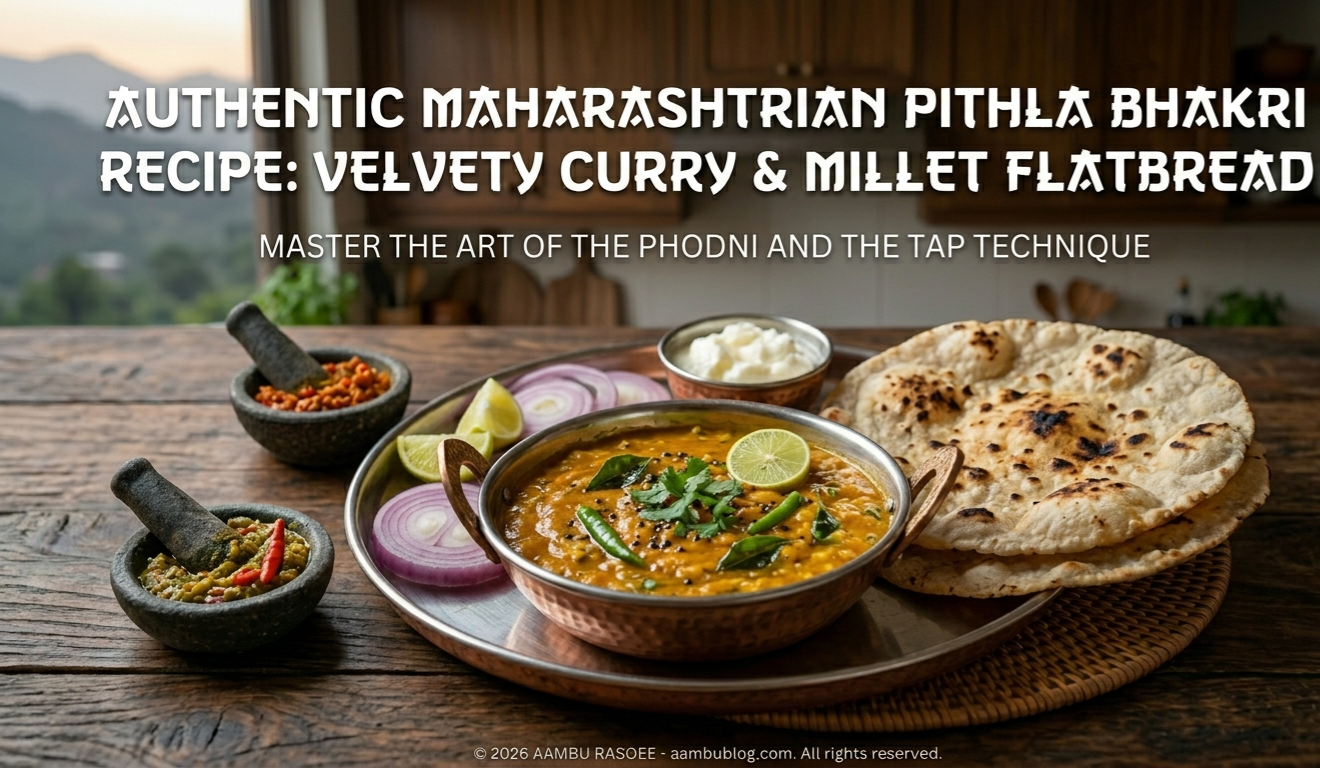
Welcome to AAMBU RASOEE, where we bring you authentic flavors from the heart of Navi Mumbai. After traveling from Rome to Indonesia, we are bringing it back home to Maharashtra with the ultimate soul food: Pithla Bhakri.
Pithla is a velvety, spiced curry made from chickpea flour, while Bhakri is a dense, wholesome millet flatbread. This combination is a classic of rural Maharashtra, beloved for its simplicity, protein content, and rich, smoky phodni (tempering). Mastering Pithla is all about texture control—making a smooth, luscious curry without a single lump.
The Science of Pithla: The Phodni and Gelatinization
The magic of Pithla lies in the Phodni (tempering). We begin with a high-temperature oil base, adding mustard seeds and hing. When the chickpea flour slurry hits this hot tempering, the starch immediately gelatinizes, trapping the aromas. Constant stirring is non-negotiable here; it creates that perfectly smooth consistency and ensures the besan cooks through completely, eliminating any raw taste.
Ingredients (Serves 2-3)
For the Pithla (Chickpea Curry):
- Besan (Chickpea Flour): 1 Cup (fine quality is best).
- Onion: 1 Medium (finely chopped).
- Garlic-Ginger Paste: 1 tsp.
- Green Chilies: 2-3 (slit lengthways).
- Mustard Seeds (Rai): ½ tsp.
- Cumin Seeds (Jeera): ½ tsp.
- Asafoetida (Hing): A pinch.
- Turmeric Powder (Haldi): ½ tsp.
- Curry Leaves: 6-8 (fresh).
- Water: 3 Cups (approx. Ratio 1:3 besan to water).
- Salt: To taste.
- Oil: 2 tbsp.
- Garnish: Freshly chopped cilantro and a squeeze of lime.
For the Bhakri (Millet Flatbread):
- Jowar (Sorghum) or Bajra (Pearl Millet) Flour: 1.5 Cups (must be fresh for the best bind).
- Warm Water: About ½ Cup (adjust as needed for kneading).
- Salt: A pinch.
Step-by-Step Instructions
Step 1: The Besan Slurry (Lump-Free Foundation)
In a large bowl, whisk the besan with 3 cups of water. Add the water gradually. Whisk constantly until you have a thin, completely smooth, lump-free slurry. Pro-Tip: If you see any stubborn lumps, use your clean fingers to mash them against the side of the bowl. Set this aside.
Step 2: The Phodni (Aromatic Tempering)
- Heat oil in a wok or heavy-bottomed pan over medium heat.
- Add mustard seeds. Once they splutter, add cumin seeds, hing, and curry leaves.
- Add the ginger-garlic paste and slit green chilies. Sauté for 30 seconds.
- Add the chopped onion and sauté until they are translucent (about 4 minutes). Do not let them brown too much.
- Add the turmeric powder.
Step 3: The Slow Cook (Texture & Flavor)
- Reduce Heat to Low. This is crucial.
- Stir the besan slurry once more, then pour it into the hot oil mixture in a steady stream.
- STIR CONSTANTLY. Using a wooden spoon or spatula, keep stirring as the slurry hits the pan. The starch will gelatinize instantly, making it thicken rapidly. Constant stirring ensures it cooks smoothly.
- Add salt to taste.
- Cover and cook on very low heat for 8-10 minutes. Stir occasionally to ensure it is not sticking to the bottom. The Pithla is ready when it is thick, luscious, and leaves the sides of the pan slightly.
Step 4: Mastering the Bhakri (Millet Dexterity)
- In a flat plate (paraat), take the jowar/bajra flour and salt.
- Gradually add warm water and start kneading. Pro-Tip: Kneading Bhakri requires more force and time than regular wheat flour. Knead until the dough becomes soft, pliable, and smooth. A well-kneaded dough will have better binding.
- Take a ball of dough. The Tap Technique: Unlike rolling regular rotis, Bhakri is traditionally flattened by tapping (थापणे). Gently pat the dough ball between your palms, then place it on a clean, dusted surface. Using your palm and fingers, tap gently and evenly, rotating the Bhakri in a circle to maintain a thick, uniform disc. (See Image overlay icon reference, if desired for technique hint).
- Cooking: Place the tapped Bhakri on a hot griddle (tawa) on medium heat.
- The Puff: After 1-2 minutes, flip it. For jowar bhakri, it is traditional to cook it first on the tawa, then place it directly on the open gas flame, where it should ideally puff up completely like a balloon. Bajra bhakris are usually cooked entirely on the tawa. Serve hot with a dollop of fresh butter (loni).
📊 Nutrition Information (Per Serving/Pithla with 1 Bhakri)
| Nutrients | Amount Per Serving | % Daily Value* |
|---|---|---|
| Calories | 410 kcal | 21% |
| Total Fat | 12g | 15% |
| Saturated Fat | 2.5g | 12% |
| Cholesterol | 0mg | 0% |
| Total Carbs | 62g | 22% |
| Dietary Fiber | 10.5g | 38% |
| Sugars | 8g | — |
| Protein | 14g | 28% |
| Sodium | 440mg | 19 |
AAMBU RASOEE’s Pro-Tips for Perfection
- The Slurry Check: The biggest mistake is not properly combining the water and besan. Ensure your slurry is entirely lump-free before it goes in the pan. A quick finger-mash is your best friend here.
- The No-Browning Rule: Do not over-sauté the onions. They should be soft and translucent; if they are too brown or fried, their texture will compete with the velvety Pithla.
- The Bhakri Dexterity: Making good bhakri takes practice. If you are struggling with the tapping technique, you can use two sheets of thick plastic to gently press and roll the bhakri with a rolling pin, but warm water and vigorous kneading are always required for binding.