
🔴 Non-Veg / Contains Chicken & Gluten | 🥘 Main Course / Japanese Cuisine
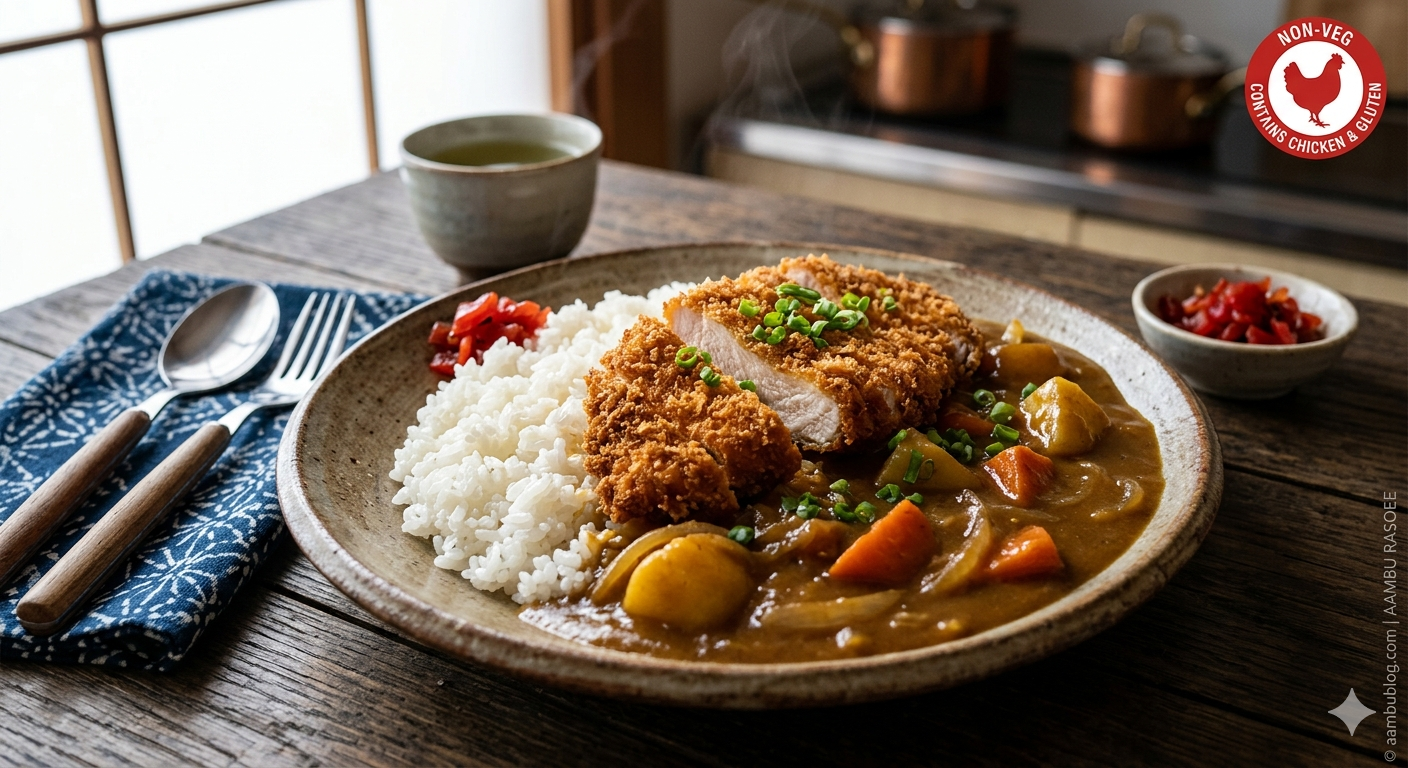
When people think of Japanese food, they often think of sushi, but in Japan, the absolute favorite home-cooked meal is Curry Rice (Kare Raisu). Combine that with a crispy, golden, panko-crusted chicken cutlet (Katsu), and you have a masterpiece. Unlike spicy Indian curries, Japanese curry is thick, savory, slightly sweet, and incredibly comforting. At Aambu Rasoee, we are bringing you the authentic homestyle method, complete with the secret ingredients that Japanese mothers use to elevate their curry.
📊 Nutrition Information (Per Serving)
| Nutrient | Amount |
|---|---|
| Calories | 720 kcal |
| Protein | 35.0 g |
| Fiber | 5.0 g |
| Total Fat | 28.0 g |
🛒 Detailed Ingredients
1. The Crispy Chicken Katsu:
- Chicken Breast: 2 large (Pounded to an even ½-inch thickness)
- Salt & Black Pepper: To taste
- All-Purpose Flour (Maida): 1/2 cup
- Eggs: 2 large (Beaten)
- Panko Breadcrumbs: 1.5 cups (Panko is essential; do not use regular breadcrumbs!)
- Neutral Oil: For shallow frying (Canola or Sunflower oil)
2. The Rich Japanese Curry:
- Japanese Curry Roux Blocks: 1/2 box (Brands like S&B Golden Curry or Vermont Curry are authentic and mandatory)
- Yellow Onion: 2 large (Sliced into thin half-moons)
- Carrots: 2 medium (Peeled and cut into rolling wedges/chunks)
- Potatoes: 2 medium (Peeled and cut into large chunks)
- Neutral Oil: 1 tbsp
- Chicken Broth or Water: 3 cups (Check the roux box for exact liquid ratios)
3. The “Secret” Flavor Enhancers:
- Soy Sauce: 1 tbsp
- Ketchup: 1 tbsp (Adds a beautiful tanginess)
- Fuji Apple: 1/2 apple (Peeled and finely grated)
4. To Serve:
- Short-Grain Japanese Rice (Sushi Rice): Steamed and sticky
- Fukujinzuke (Red Pickled Radish): Optional, for authentic garnish
👩🍳 Preparation & Cooking Instructions
Step 1: Simmering the Curry Base
- Heat 1 tablespoon of oil in a large heavy-bottomed pot or Dutch oven over medium heat. Add the sliced onions and sauté for 8-10 minutes until they are deeply caramelized and sweet.
- Add the carrots and potatoes, sautéing for another 2 minutes.
- Pour in the chicken broth (or water) and bring to a boil.
- Skim off any foam that rises to the top. Reduce the heat to low, cover the pot, and let it simmer for 15 minutes until the potatoes and carrots are easily pierced with a fork.
Step 2: The Perfect Katsu Breading Station
- While the curry simmers, set up your breading station with three wide, shallow dishes: one for flour, one for beaten eggs, and one for the Panko breadcrumbs.
- Season the pounded chicken breasts lightly with salt and pepper on both sides.
- Coat the chicken completely in the flour, shaking off the excess. Dip it into the egg wash, ensuring it’s fully covered. Finally, press the chicken firmly into the Panko breadcrumbs so the flakes stick to every inch.
Step 3: Frying the Katsu
- Heat about ½ inch of oil in a large skillet over medium-high heat (around 170°C).
- Carefully lay the breaded chicken into the hot oil. Fry for 4-5 minutes on each side until the crust is a deep, gorgeous golden brown and the chicken is cooked through.
- Remove the chicken and let it rest on a wire cooling rack (not paper towels, which make the bottom soggy) for 3 minutes. Slice it into thick strips.
Step 4: Melting the Curry Roux
- Once the vegetables in the pot are tender, turn off the heat completely. This is crucial!
- Break the Japanese curry blocks into pieces and dissolve them gently into the hot broth using a ladle.
- Once fully dissolved, turn the heat back on to the lowest setting. Stir in the soy sauce, ketchup, and the grated apple. Let it simmer for 5 minutes until the curry becomes thick and glossy.
Step 5: The Authentic Plating
Place a generous mound of sticky, short-grain rice on one half of the plate. Pour the thick, rich curry over the other half of the plate (and slightly touching the rice). Place the sliced, crispy Chicken Katsu gently on top of the curry sauce so it stays crunchy!
❓ Frequently Asked Questions (FAQ)
Q: Can I make the curry from scratch without the store-bought blocks?
A: You can, but using boxed curry roux is actually the most authentic way to make it! 99% of Japanese households and many restaurants use brands like Golden Curry. It guarantees that perfect, thick, nostalgic flavor.
Q: Why do I have to turn off the heat before adding the curry blocks?
A: The curry blocks contain flour as a thickener. If you drop them into boiling water, the starches will instantly clump together, and your sauce will be lumpy instead of silky smooth.
Q: Can I use regular long-grain Basmati rice?
A: Japanese curry is traditionally eaten with a spoon, and short-grain “sticky” rice is designed to clump together so you can scoop it up easily with the thick sauce. Basmati will work in a pinch, but short-grain rice gives the true Japanese experience!
💡 Aambu Blog Secret Tip
”The secret to a truly restaurant-quality Japanese curry is the grated apple and a touch of ketchup! The Japanese call this ‘Kakushi-aji’ (hidden flavor). The apple breaks down into the sauce, providing a natural, fruity sweetness that perfectly balances the savory, salty, and spicy notes of the curry roux.”